What Is the Crypto Fear and Greed Index? 7 Ways to Read Market Fear Without Panicking
The crypto fear and greed index is one of the most talked-about numbers in the crypto world — a single score from 0 to 100 that tries to capture how the whole market is feeling. When the score is low, fear is running the show. When it is high, greed is taking over. It sounds simple, and that is exactly why beginners love it. But the number only helps if you understand what it actually measures, what it does not measure, and how to use it without letting it push you into rushed decisions. This article explains it in plain English.
1. What the Crypto Fear and Greed Index Actually Is
The crypto fear and greed index is a daily score that summarizes the emotions driving the crypto market. A score near 0 means “extreme fear” — investors are worried and selling. A score near 100 means “extreme greed” — investors are excited and buying aggressively. The most commonly cited version, published by Alternative.me, is built mainly around Bitcoin, but because Bitcoin tends to set the tone for the wider market, many people treat it as a rough mood reading for crypto as a whole.
2. The Five Mood Levels, Explained
The index divides its 0–100 scale into five bands:
- 0–24 — Extreme Fear: panic selling is common, and headlines are usually negative.
- 25–49 — Fear: investors are cautious and many are sitting on the sidelines.
- 50 — Neutral: the market is balanced, with neither fear nor greed dominating.
- 51–74 — Greed: optimism is growing and buying interest is picking up.
- 75–100 — Extreme Greed: excitement is high, and fear of missing out can drive rushed buying.
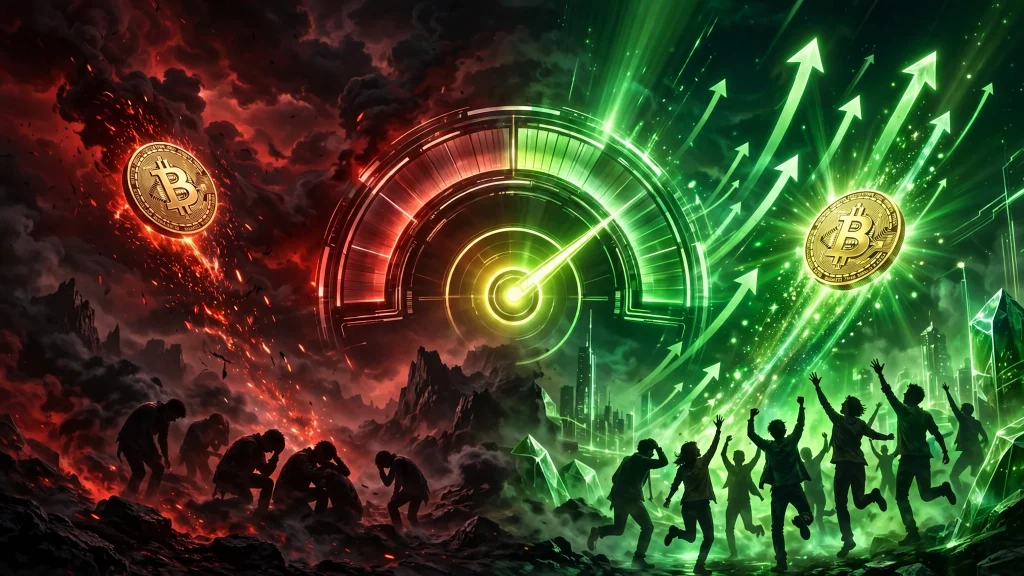
The number is often shown on a colorful gauge — red on the fear side, green on the greed side — which makes it easy to read at a glance.
3. How the Score Is Calculated
The index is not a survey of a few traders. It combines several data sources into one number, with each factor weighted differently:
- Volatility (25%): unusual price swings compared with recent averages.
- Market volume and momentum (25%): how much is being traded and whether buying is outpacing selling.
- Social media (15%): how often crypto is mentioned and whether the tone is positive or negative.
- Surveys (15%): polls of market participants about their outlook.
- Bitcoin dominance (10%): Bitcoin’s share of the total crypto market.
- Google Trends (10%): how often people search for Bitcoin and related terms.
Because it blends so many signals, the index can change quickly when the market mood shifts — a sharp drop can move it from greed into fear within a day or two.
4. Why Extreme Fear Does Not Mean “Buy Now”
A popular saying in investing is to “be fearful when others are greedy, and greedy when others are fearful.” It sounds clever, but it is not a trading rule. An extreme fear reading only tells you that sentiment is very negative — it says nothing about whether prices have finished falling. Markets can stay fearful for weeks, and a low score can get even lower. Treat extreme fear as a prompt to slow down and learn, not as a green light to buy.
5. Why Extreme Greed Is a Time to Be Extra Careful
Extreme greed readings often appear near market tops, when excitement is at its peak and everyone seems to be buying. That is exactly when beginners are most tempted to jump in with money they cannot afford to lose. Greed does not mean a crash is coming tomorrow — markets can stay greedy for a while — but it does mean expectations are high and disappointment can hit hard. If a reading of extreme greed makes you feel rushed, that feeling itself is useful information.
6. How Beginners Can Use the Index Sensibly
Here are seven practical ways to use the crypto fear and greed index without letting it control your decisions:
- Use it as a mood check, not a signal. It describes sentiment, it does not predict prices.
- Watch the trend, not one day. A single reading is noise; a shift over several days tells you more.
- Pair it with learning. When fear is high, it is a good time to study how markets work — for example, how forced selling can accelerate a drop, as explained in our guide on crypto liquidations.
- Do not trade on the number alone. No single indicator should decide a buy or sell.
- Check what is driving the mood. A fear reading after a major hack or a big market drop has a different context than one during a quiet week.
- Remember it is Bitcoin-weighted. Altcoins can behave very differently from the index’s mood.
- Keep your own plan. If you have a long-term learning plan, a scary gauge reading should not rewrite it overnight.
7. The Limits Every Beginner Should Know
The index has real limits. It is backward-looking — it measures what has already happened, not what will happen next. Social media and search data can be noisy or manipulated. And because it is a single number, it hides all the detail: it cannot tell you why people are afraid, which coins are affected, or how long the mood will last. Think of it like a thermometer: it tells you the temperature, but it cannot tell you whether to wear a coat tomorrow. For that, you need context, patience, and your own research.
The Bottom Line
The crypto fear and greed index turns the market’s mood into one easy number, from 0 (extreme fear) to 100 (extreme greed). It is a useful way to understand sentiment and to check your own emotions against the crowd — but it is not a crystal ball, a buy signal, or financial advice. The smartest way to use it is as a reminder to pause: when fear is extreme, resist panic; when greed is extreme, resist rushing in. Calm, informed decisions beat emotional ones every time.
If this helped you make sense of a confusing crypto number, share it with a friend who is new to crypto — it might help them stay calm the next time the market gets loud.
Disclaimer: This article is for educational purposes only and is not financial advice. Cryptocurrency prices are volatile. Always do your own research before buying any crypto asset.