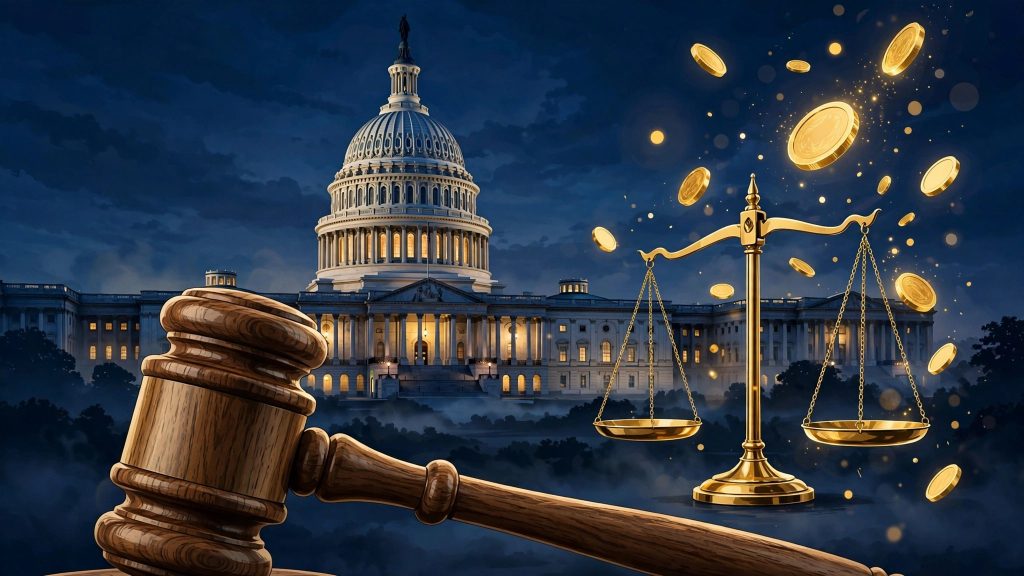
Crypto Regulation in the USA: 7 Facts About the CLARITY Act Every Beginner Should Know
Crypto regulation in the USA is one of the most confusing topics for beginners — and one of the most important. For years, nobody could say clearly which government agency is in charge of crypto, or whether a token is a security or a commodity. The CLARITY Act is the biggest attempt so far to answer those questions in one law. Here are seven facts that explain what it is, where it stands, and what it could mean for you.
1. What Is the CLARITY Act?
The CLARITY Act is short for the Digital Asset Market Clarity Act of 2025 (H.R. 3633), a bill in the US Congress that would create a clear set of rules for crypto markets — who regulates what, how tokens are classified, and what exchanges and issuers must do to operate legally.
Think of it as a rulebook. Today, crypto companies in America often have to guess which rules apply, and different agencies have given different answers. The CLARITY Act would write the answers down in one place, so a project, an exchange, or an ordinary user could know where they stand.
2. Why Does Crypto Regulation in the USA Need a New Law?
The main problem is a turf question: the Securities and Exchange Commission (SEC) regulates securities, such as stocks, while the Commodity Futures Trading Commission (CFTC) regulates commodities, such as wheat, oil, and gold. But most cryptocurrencies do not fit neatly into either box.
Bitcoin is widely treated as a commodity, while other tokens were sold to raise money for a project, which can look like a security offering. When one asset can be described two ways, companies face lawsuits, exchanges face uncertainty, and beginners face rules that change depending on who is asking. A market structure law would draw the line once and for all.
3. Who Would Regulate What: SEC vs CFTC
Under the CLARITY Act, the CFTC would oversee spot markets for “digital commodities” — tokens like Bitcoin that are widely distributed and not tied to an investment contract — while the SEC would keep authority over fundraising and tokens sold as investment contracts, using the long-standing Howey test courts apply to decide whether something is a security.
In practice, which agency applies would depend on what the token is and how it was sold, not on guesswork. Exchanges would register with the right regulator, and users would get clearer information about which platforms are registered, what they must disclose, and where to complain. Some large crypto firms are also applying for a national trust charter, which would place them under federal banking supervision.
4. Where Does the CLARITY Act Stand Right Now?
This is the part beginners get wrong most often: the CLARITY Act is not law yet. The House of Representatives passed it on July 17, 2025, by 294 votes to 134, with support from both parties. But a bill becomes law only after the Senate passes it and the president signs it.
In the Senate, a procedural vote to take up the bill failed 49 to 50 on September 15, 2026 — short of the 60 votes needed. A motion to reconsider keeps it alive on the Senate calendar, but as of November 2026 no new vote is scheduled. The current Congress ends on January 3, 2027, and if the bill has not become law by then, it would have to be reintroduced and start over in the next Congress.
5. What About Stablecoins and the GENIUS Act?
Stablecoins already have their own law: the GENIUS Act, which sets rules for payment stablecoins, was signed on July 18, 2025, and takes effect on January 18, 2027.
The two laws cover different ground: the GENIUS Act covers dollar-pegged stablecoins, while the CLARITY Act would cover the wider crypto market — exchanges, tokens, and trading. If you want to understand how stablecoins keep their $1 peg, our guide on stablecoins explained covers the basics.
6. What Would Change for Everyday Crypto Users?
If the CLARITY Act or a similar law passes, three things would matter most to ordinary users. First, registered exchanges would have clearer duties — such as keeping customer funds separate from company funds — which should make scams and collapses harder. Second, it would be easier to tell whether a platform is properly registered, because the registration categories would be written into the law. Third, token projects would have a defined path to operate legally in the USA instead of leaving the country.
None of this removes risk: crypto prices would still be volatile, and no law can guarantee that a token goes up in value. What regulation can do is make the market more transparent and protect users better. Until a law passes, the agencies are filling the gap: the SEC has proposed a crypto asset framework, and the CFTC is taking public comments on new crypto market proposals until December 14, 2026.
7. What Should Beginners Watch Next?
You do not need to follow every vote in Congress, but three milestones matter: whether the Senate schedules another vote before this Congress ends on January 3, 2027; whether a new version appears in the next Congress; and what the SEC and CFTC do on their own, since their rules will shape the market even if Congress stays stuck.
The practical lesson is the same as always: the rules affect your taxes, your exchange, and your rights as a customer. Our guide on crypto taxes in the USA explains what you already owe the IRS under today’s rules, whatever happens with the CLARITY Act. And if you hold crypto through a fund, our guide on crypto ETFs explains how those products work inside a normal brokerage account.
The Bottom Line
Crypto regulation in the USA is still unfinished business. The CLARITY Act is the clearest plan yet to divide crypto oversight between the SEC and the CFTC, and it has passed the House — but it stalled in the Senate in September 2026 and is not law. Stablecoins already have their own law in the GENIUS Act, while the wider market waits for Congress or the agencies. For beginners, the takeaway is simple: know today’s rules, keep learning as they change, and never assume a bill is law until it actually is.
If this guide helped you make sense of crypto regulation in the USA, share it with a friend who is confused about who regulates crypto — it might be the clearest explanation they read all week.
Disclaimer: This article is for educational purposes only and is not financial advice. Cryptocurrency prices are volatile. Always do your own research before buying any crypto asset.