Seed Phrase Safety: 7 Rules to Store Your Crypto Recovery Phrase
What Is a Seed Phrase, and Why Does It Matter?
Seed phrase safety starts with one simple idea: your seed phrase is the master key to your crypto wallet. A seed phrase, also called a recovery phrase, is a list of 12 or 24 ordinary words created when you first set up a wallet. Those words can restore your entire wallet — and every coin inside it — on any device, anywhere in the world.
Your wallet password only locks one app on one phone. Your seed phrase can rebuild the whole wallet. If someone else gets it, they can restore your wallet on their own device and move your funds. If you lose it and lose access, nobody — not the wallet company or support — can recover it for you.
That sounds scary, but protecting your recovery phrase is simple, cheap, and mostly a one-time job once you know the rules.
Seed Phrase Safety Rule 1: Write It Down by Hand, on Paper
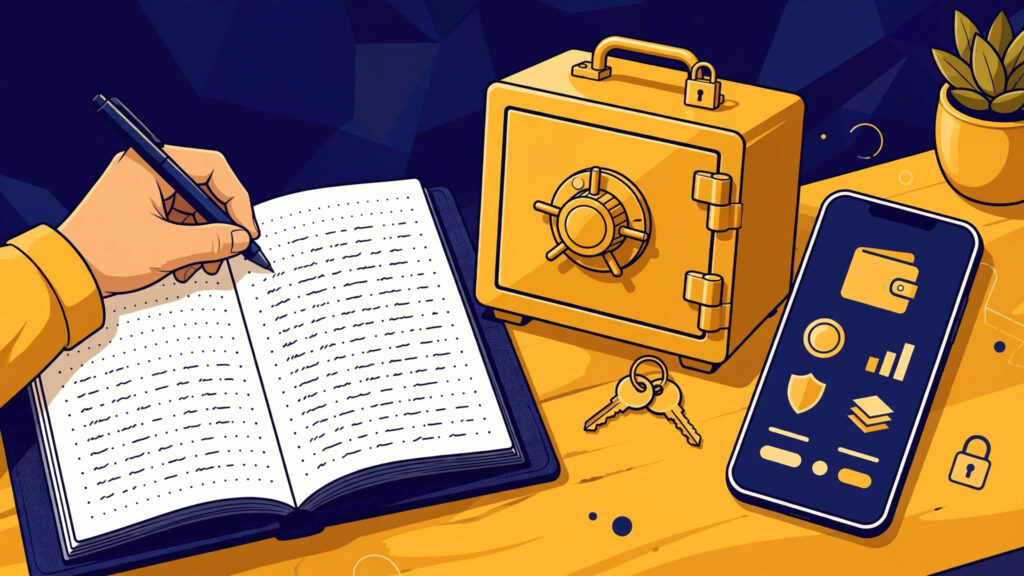
When your wallet shows you the seed phrase for the first time, write every word down by hand, in the exact order shown, and double-check the spelling. Use a pen, not a pencil, so the words cannot fade or smudge easily.
Why paper? Because paper is offline. It cannot be hacked or copied by malware. If you can, write it twice and store the copies in two different safe places, so a fire or burglary at one place does not leave you with nothing.
Rule 2: Never Store Your Seed Phrase Online
This is the most common beginner mistake, and the easiest to avoid:
- Do not take a photo or screenshot of your seed phrase.
- Do not save it in a notes app, email draft, Google Doc, or cloud drive.
- Do not send it to yourself by text message, email, or chat app.
- Do not type it into any website or form that asks for it — unless you are deliberately restoring your own wallet in an app you trust.
Anything stored online can be copied, synced, or stolen in ways you cannot see. A screenshot on your phone may be automatically uploaded to the cloud, even if you never meant to share it. If your seed phrase only exists on paper, that whole category of risk disappears.
Rule 3: Never Share It With Anyone — Not Even Support
No legitimate wallet company, exchange, or support agent will ever ask for your seed phrase. If someone messages you claiming to be support and asks for your 12 or 24 words to “verify,” “unlock,” or “fix” your wallet, that is a scam — full stop.
Be careful with people you know, too. Do not read your seed phrase aloud on a call, show it on a video chat, or let a friend “hold a copy just in case” unless you fully understand the risk. Every extra person who knows your phrase is another way it can be lost or copied. For more on the tricks scammers use, read our guide to the top 10 crypto scams and red flags every beginner must know.
Rule 4: Test Your Backup Before You Fund the Wallet
Before you send any meaningful amount of crypto to a new wallet, test your backup:
- Write the seed phrase down carefully.
- Reset the wallet app (only after you are sure the written copy is complete).
- Restore the wallet using only your written words.
- Confirm the wallet address matches the original.
This short test proves your backup actually works while the wallet is still empty. Finding a spelling mistake after you have funded the wallet is a nightmare; finding it during a test costs you nothing.
Rule 5: Protect Your Paper Backup Like Cash
Treat your written seed phrase like cash or a passport. Keep it in a waterproof pouch inside a locked drawer or safe, away from printers and webcams — never scan or photograph it. A metal backup plate survives fire and water better than paper if you hold a large amount. And do not label it obviously; a plain, unmarked backup in a safe place is much better.
If you use a hardware wallet, the same rules apply. To understand the difference between wallet types, see our explainer on hot wallets vs cold wallets and which is safer for beginners.
Rule 6: Beware of Fake Recovery Forms and Phishing
Scammers build convincing fake wallet websites and apps that look exactly like the real thing. Their goal is simple: get you to type your seed phrase into their form. Once you do, your funds can be drained in minutes.
- Only download wallet apps from the official app store listing or the official website — never from a link in a message, ad, or comment.
- Bookmark the official site of your wallet and use the bookmark, not search results, which can include ads for fake sites.
- Never enter your seed phrase on a website that promises to “sync,” “validate,” or “migrate” your wallet. Real wallets do not work that way.
- If a message creates urgency — “your wallet will be frozen in 24 hours unless you verify” — treat it as a scam and ignore it.
Rule 7: Have a Plan if Something Goes Wrong
If your phone is lost, your funds are still safe if nobody has your seed phrase: restore with your written backup on a new device. If your paper backup is damaged or lost, create a new wallet, test its new backup, and move your funds there. A lost device is an inconvenience; a lost seed phrase, with no backup, is usually permanent.
Seed Phrase Safety Checklist
- Write it by hand, in order, and check every word.
- Keep it offline — never in photos, cloud notes, or messages.
- Never share it with anyone, including “support.”
- Test your backup on an empty wallet before funding it.
- Store copies in two separate safe places.
- Never type it into a website, form, or unfamiliar app.
- Replace the wallet if your backup is lost, damaged, or exposed.
Follow those seven rules and you have avoided the mistakes that cost most beginners their crypto. Seed phrase safety is mostly about slowing down, writing things down correctly, and keeping one secret truly offline.
Found this guide helpful? Share it with a friend who is new to crypto — it might save them from a costly beginner mistake.
Disclaimer: This article is for educational purposes only and is not financial advice. Cryptocurrency prices are volatile. Always do your own research before buying any crypto asset.